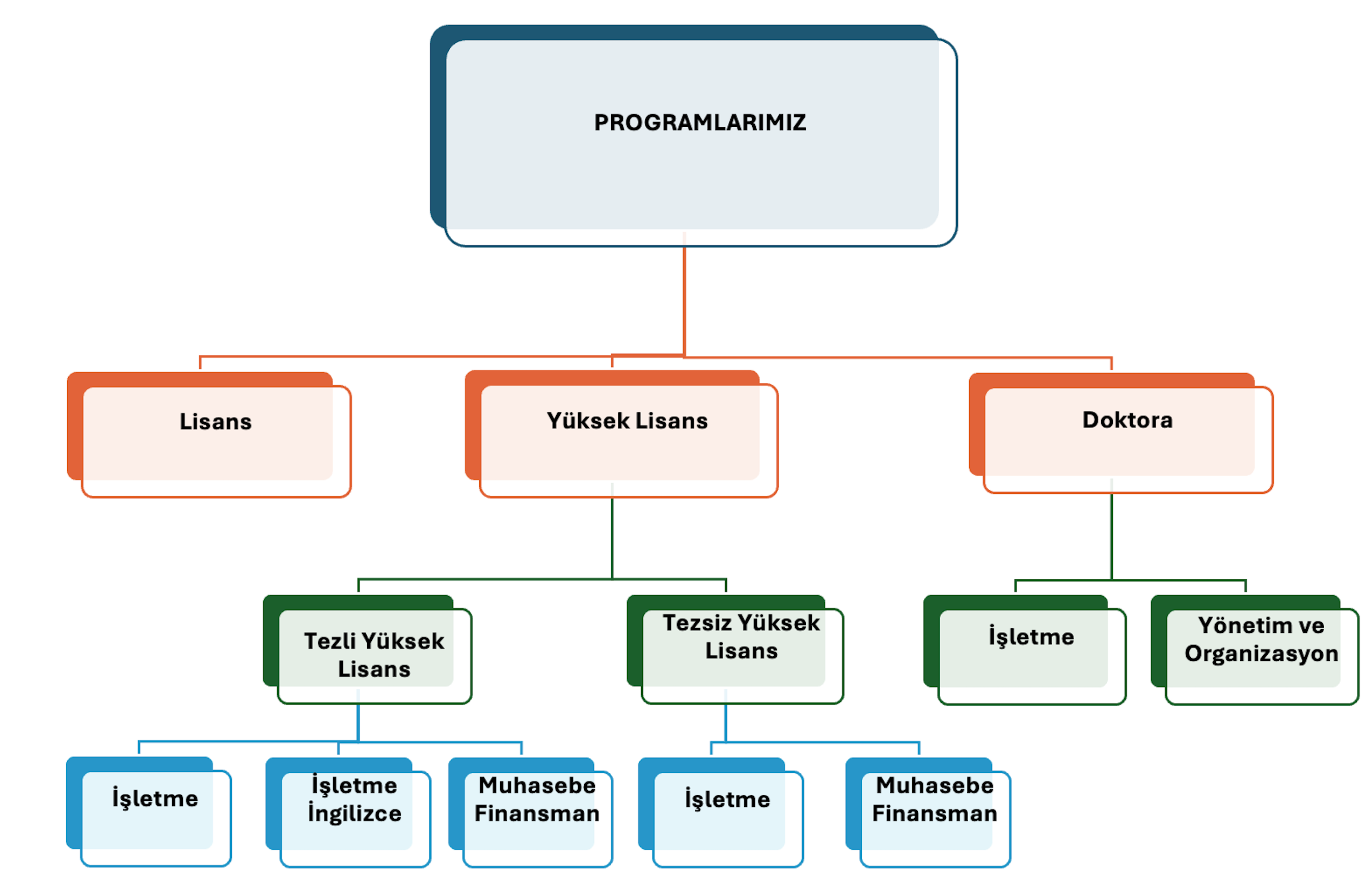
The Department of Business Administration commenced its academic activities with a graduate program in the 1995–1996 academic year, admitted undergraduate students in the 1996–1997 academic year, and launched its doctoral program in the 1999–2000 academic year. As of the 2025–2026 academic year, the department offers one undergraduate and seven graduate programs.
The Undergraduate Business Administration Program aims to educate individuals who are capable of working in both the public and private sectors, performing data-driven analyses, and developing solutions to business problems. Furthermore, the program seeks to equip students with the ability to integrate entrepreneurship, lifelong learning, and the principles of ethics and sustainability into professional practice.
Within the scope of internationalization, students are encouraged to gain experience in diverse academic environments through Erasmus+ and similar exchange programs. Students who meet the necessary requirements may also benefit from double major and minor opportunities.
Graduates can pursue careers in areas such as finance, marketing, accounting, human resources, and management in both public and private sectors. They may also establish and manage their own businesses in line with their entrepreneurial knowledge and skills, or continue their academic development through graduate studies.
Our Mission
Our mission is to contribute to the development of a qualified workforce for our country by educating individuals who possess contemporary management knowledge and skills to lead public and private sector organizations; who can think strategically, act innovatively, perform data-driven analyses, and develop solutions; who adopt an interdisciplinary perspective; and who integrate ethical principles, social responsibility, and sustainability into their professional practices.
Our Vision
Our vision is to become a reputable department at both national and international levels that conducts scientific research, education, and community engagement at a universal standard; fosters individuals with strong analytical thinking and problem-solving skills; develops pioneering approaches; and embraces continuous improvement.
Our Programs
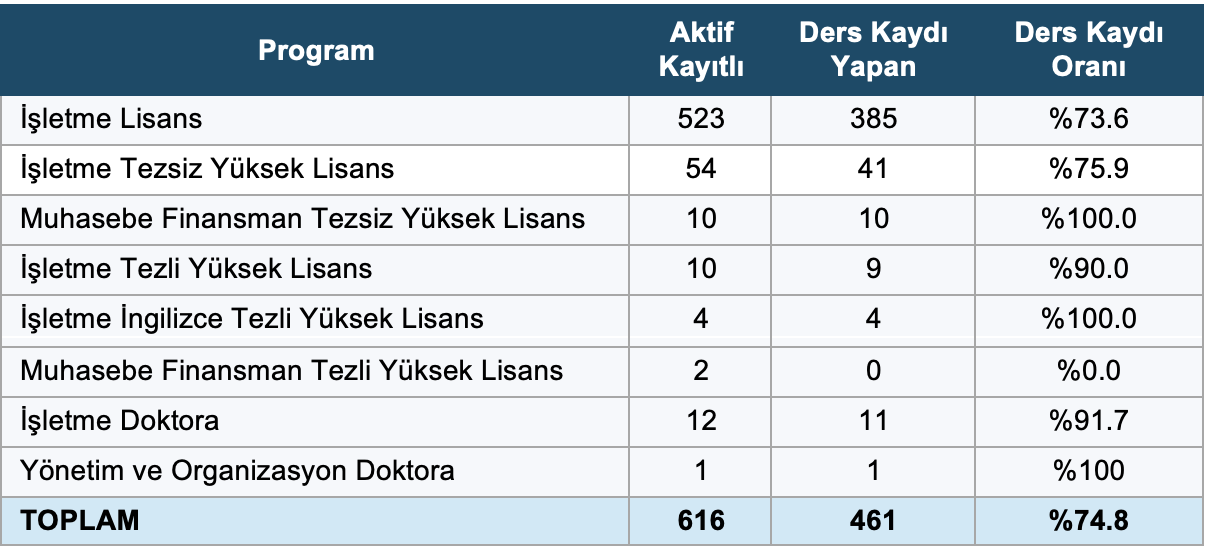
As of the 2025–2026 academic year, the department offers one undergraduate program and seven graduate programs. A total of 616 students are enrolled in the department, of whom 523 are undergraduate students, 80 are master’s students, and 13 are doctoral students.
Sample Courses from Our Curriculum
Core Courses: Mathematics, Introduction to Economics, Principles of Accounting, Introduction to Business Administration, Behavioral Sciences, Management and Organization, Principles of Marketing, Financial Literacy, Organizational Behavior, Research Methods, etc.
Specialization Courses: Organizational Design, Digital Marketing, Operations Research, Cost Accounting, Commercial Law, Production Management, Marketing Management, Management Across Cultures, Human Resource Management, International Finance, etc.
Program-Specific Elective Courses: Sustainability Management, Ethical Dilemmas in Organizational Behavior, Brand Management, Project Analysis, Statistical Methods in Management, Innovation Management, Case Studies in Business Administration, Case Studies in Financial Management, Case Studies in Cost and Management Accounting, Computer-Aided Machine Learning Applications, etc.
Competency-Enhancing Courses: Information Technology Applications, Career Planning, Internet Programming, Advanced Office Applications, Educational Psychology, Artificial Intelligence Literacy, AI-Based Analytical Approaches, Current Economic Issues, Human Rights, Social Responsibility and Community Engagement, etc.
Program-Specific Criteria (PSC) and Course Examples
PSC 1: The program designs learning experiences that enable students to analyze theoretical knowledge and practices related to the fundamental functional areas of business.
Course examples: ISL 397 Financial Accounting Case Studies, ISL 442 Financial Management Case Studies, ISL 459 Business Economics Applications, ISL 471 Case Studies in Business Management, etc.
PSC 2: The program creates learning environments where students can develop solution models for business problems using data analysis methods and information technologies.
Course examples: ISL 223 Introduction to Business Information Systems, ISL 226 Data Resource Management in Business, ISL 433 Statistical Methods in Management, ISL 475 Artificial Intelligence and Machine Learning, ISL 476 Computer-Aided Machine Learning Applications, etc.
PSC 3: The program designs learning experiences that enable students to analyze and critically evaluate business processes and contemporary business practices from interdisciplinary perspectives and develop innovative solutions or project proposals.
Course examples: ISL 392 Creativity and Business Idea Development, ISL 402 Contemporary Approaches in Management, ISL 411 Project Analysis, ISL 413 Innovation Management, etc.
PSC 4: The program develops learning environments where students can evaluate ethical principles, social responsibility, and sustainability within a professional context.
Course examples: ISL 221 Sustainability Management, ISL 399 Ethical Dilemmas in Organizational Behavior, etc.
Program Learning Outcomes (PLO)
Graduates of the program will be able to:
- Analyze business processes using theories and concepts related to business and management functions.
- Identify, analyze, and develop solutions to business problems using information technologies and data analysis tools.
- Analyze business data using statistical and analytical methods and develop data-driven decision alternatives.
- Conduct research on economic and social issues related to the business world using scientific research methods and report findings in accordance with academic standards.
- Plan, implement, and evaluate operational processes in business functional areas using analytical methods.
- Design feasible business models and project plans by considering financial, legal, and operational requirements in the development of a business idea.
- Analyze the impact of national and international economic, legal, and sociocultural environments on business strategies and evaluate strategic decision-making processes.
- Independently analyze multidimensional business problems by integrating disciplinary and interdisciplinary knowledge and develop applicable strategic solutions and project proposals.
- Evaluate the impact of current developments in the field of business on strategies and practices based on data and literature analysis.
- Assess business practices in line with ethical principles, social responsibility, and sustainability, and base professional decisions on these principles.
Program Educational Objectives (PEO)
PEO 1: Graduates take roles in core functional areas of business in public and private sector organizations; analyze business data, evaluate decision processes, and develop evidence-based management recommendations.
PEO 2: Graduates adopt a data-driven mindset in solving business problems; analyze digitalization and technological transformation processes; and design data-based solution models.
PEO 3: Graduates design and manage projects in entrepreneurship and project management; develop innovative business ideas; and generate strategic solutions and project proposals using interdisciplinary knowledge and approaches.
PEO 4: Graduates pursue lifelong learning by evaluating professional development opportunities, monitoring developments in the field, and continuously improving their competencies.
PEO 5: Graduates incorporate business ethics, social responsibility, and sustainability principles into their professional activities; adopt ethical and sustainable management approaches; and reflect these principles in corporate decisions and practices.
Click here for our department’s YouTube introduction.
Son güncelleme : 4.05.2026 16:12:58